What Makes a High-Converting Business Website?
A beautiful website that doesn't generate leads is a missed opportunity. Learn the 12 elements every high-converting business website needs in 2026.
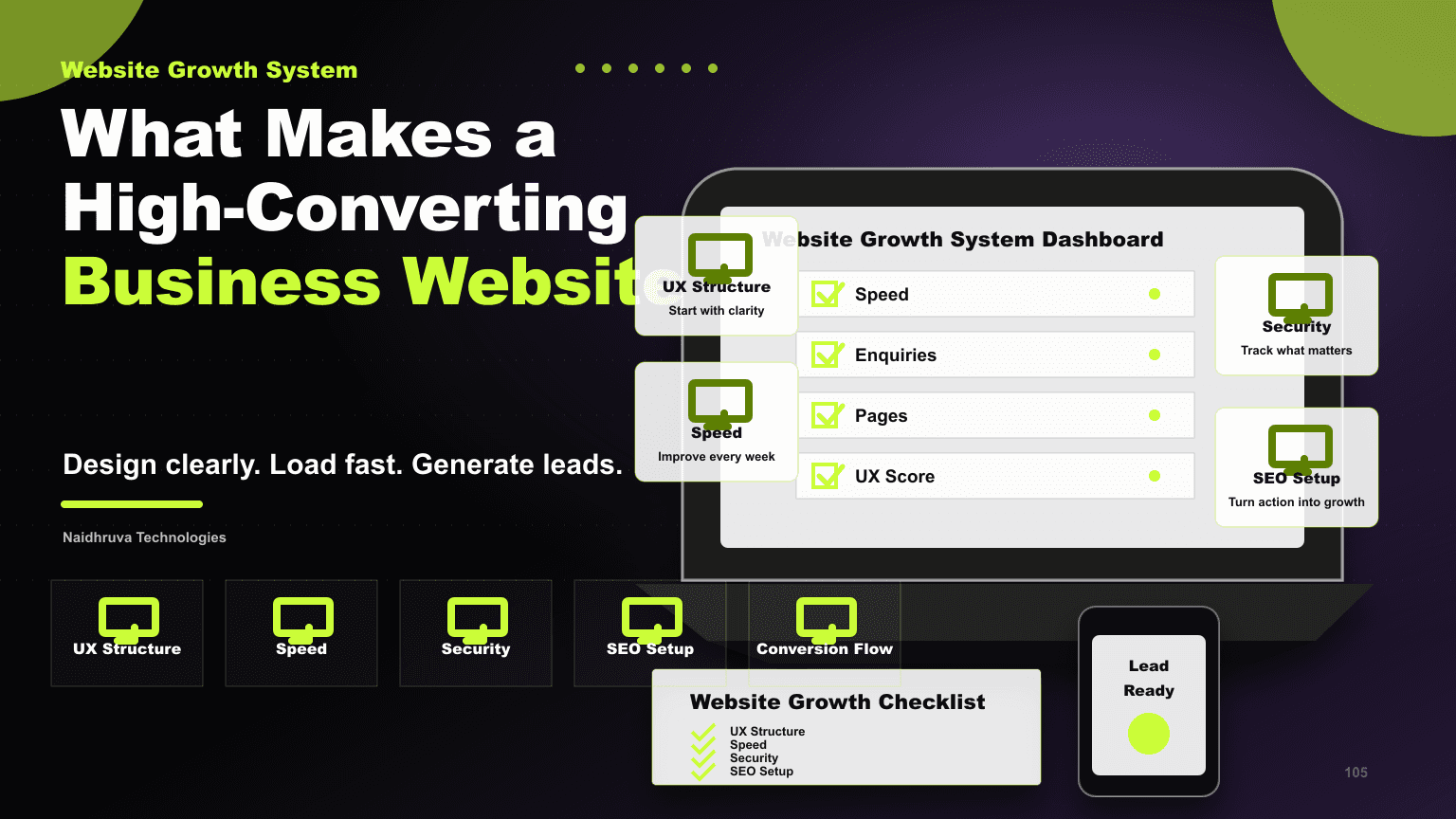
A high-converting business website turns visitors into leads, calls, and sales. It doesn't happen by accident — it's built from clear strategy, user-focused design, and continuous optimization.
1. Clear value proposition above the fold
Within 3 seconds, visitors must understand:
- What you do
- Who you serve
- Why they should choose you
Bad: "Welcome to our website."
Good: "Hyderabad's trusted partner for SEO and lead-generating websites for local businesses."
2. Fast load speed (especially on mobile)
53% of mobile users abandon sites that take over 3 seconds to load.
- Compress images (WebP format)
- Use caching and CDN
- Minimize plugins and scripts
- Target 90+ PageSpeed score on mobile
3. Mobile-first design
In India, 70%+ of web traffic is mobile. Your site must work flawlessly on phones:
- Click-to-call buttons
- Readable text without zooming
- Forms that are easy to fill on small screens
- WhatsApp contact option
4. Strong calls-to-action (CTAs)
Every page needs a clear next step:
- "Get a Free Quote"
- "Book a Consultation"
- "Call Now"
Use contrasting button colors. Repeat CTAs after key sections — not just in the header.
5. Trust signals
Indian customers research before buying. Build trust with:
- Client logos and testimonials
- Google review count and rating
- Case studies with real results
- Certifications and team photos
- Physical address and phone number
6. Dedicated landing pages for services
Don't list 10 services on one page. Create separate pages for each major service with:
- Specific benefits
- Process explanation
- FAQ section
- Relevant CTA
This improves both conversions and SEO.
7. Social proof and reviews
Embed Google reviews or showcase written testimonials with names and businesses. Video testimonials convert even better.
8. Simple navigation
Visitors should reach any important page in 2 clicks or fewer. Avoid cluttered menus with 20+ items.
9. Lead capture without friction
Forms should ask for essentials only:
- Name
- Phone or email
- Brief message
Long forms kill conversion. Offer WhatsApp as an alternative for Indian users.
10. Analytics and conversion tracking
Install Google Analytics 4 and track:
- Form submissions
- Phone clicks
- WhatsApp button clicks
- Key page scroll depth
You can't improve what you don't measure.
11. SEO fundamentals built in
High-converting sites also attract organic traffic:
- Unique title tags and meta descriptions
- Proper heading structure (H1, H2, H3)
- LocalBusiness schema for local companies
- Internal links between service pages
12. Continuous testing
Run monthly reviews:
- Which pages get traffic but no leads? (fix messaging/CTA)
- Which pages convert best? (apply patterns elsewhere)
- A/B test headlines and button text
Conversion rate benchmarks
| Industry | Good conversion rate | |----------|---------------------| | Local services | 3–8% | | B2B services | 2–5% | | E-commerce | 1–3% |
A site converting at 1% that gets 1,000 visitors/month = 10 leads. At 5% = 50 leads — same traffic, 5× results.
Common conversion killers
- Slow speed
- No clear CTA
- Generic stock photos with no personality
- Broken forms
- No mobile optimization
- Walls of text with no headings
- Autoplay videos with sound
Checklist: is your site conversion-ready?
- [ ] Value proposition clear in 3 seconds
- [ ] Mobile PageSpeed 80+
- [ ] Click-to-call on every page
- [ ] Contact form tested and working
- [ ] Testimonials visible on homepage
- [ ] Separate page per main service
- [ ] Analytics tracking form and calls
- [ ] HTTPS active
Bottom line
High-converting websites aren't the ones that win design awards — they're the ones that make it effortless for a visitor to take the next step. Invest in clarity, speed, and trust before adding fancy animations.